How to track rent for several tenants
With more than a couple of tenants, it gets hard to say who owes what unless every charge and payment is written down the same way. A ledger for each tenant, updated as money comes in and checked once a month, works in a spreadsheet or in software.
Keep one ledger per tenant
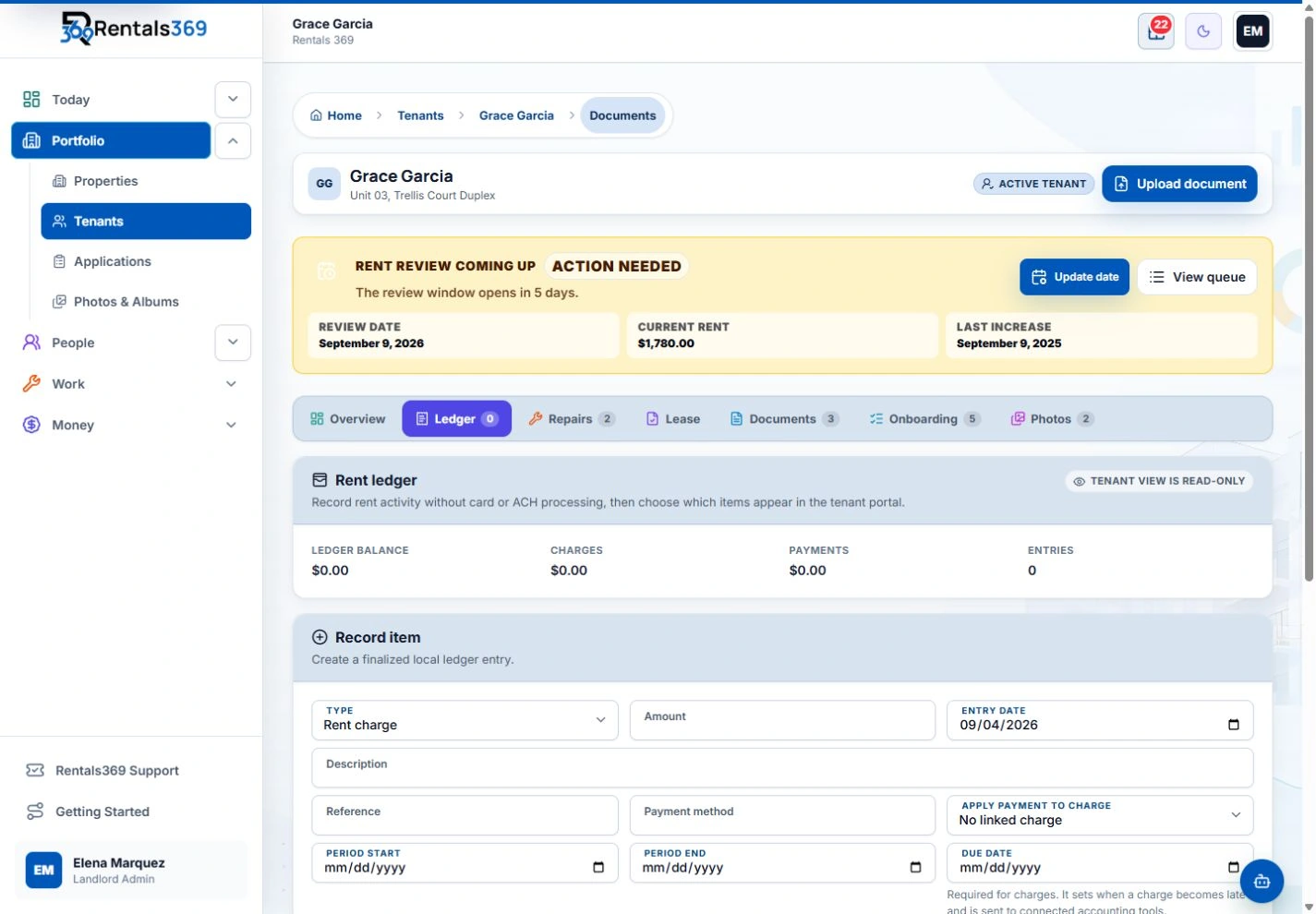
A rent ledger is a dated list of what a tenant was charged and what they paid, with a running balance after each line. Keep a separate ledger for each lease, even when several tenants live in the same building. Roommates on one lease who pay one rent share a ledger, and each payment line notes who paid.
A positive balance is what the tenant owes. Zero means they are paid up, and a negative balance is a credit, for example when someone pays next month's rent early.
The free rent ledger template has the columns you need: date, tenant, unit, description, charge, payment, balance, and notes.
Record every charge and every payment
Enter each rent charge on the day it is due, before any money arrives. The ledger then shows the tenant owing rent from the due date, and a late or missing payment shows up as an open balance.
Record other charges the same way, each on its own line: a late fee, a utility bill you pass on under the lease, or a repair the tenant agreed to pay for. Keep the security deposit off the rent ledger, or on a clearly labeled line, because deposits often have their own rules for holding and returning them.
For each payment, write the date you received it, the amount, and how it was paid. A check number, a money order number, or a bank transfer reference lets you match the line to a deposit later. Enter payments on the day they arrive, because entries made from memory at the end of the month are easy to get wrong.
Handle partial payments the same way every time
When a tenant pays part of the rent, record the amount you received and leave the charge as it was. If rent is $1,200 and the tenant pays $800, the ledger shows a $1,200 charge, an $800 payment, and a $400 balance. Write any promise about the rest in the notes, such as "Remaining $400 by October 15."
When a tenant owes more than one thing, such as rent and a late fee, a payment has to go toward one of them first. Some leases and local laws set that order. Where yours do not, pick one order and use it for every tenant so each balance is easy to explain.
In some places, accepting a partial payment can affect an eviction case that is already open. If you are in that position, check your local rules before you accept one.
Apply late fees the way your lease says
Many leases set a grace period and a late fee, which may be a flat amount, a percentage of the rent, or both. When a payment arrives after the grace period, add the fee as its own charge line, dated the day it applies, with a note that names the lease clause. Keeping it separate from the rent charge means the ledger still shows what the rent was.
Late fee limits and notice rules vary by state and city, and some places cap or ban late fees. Check your local law and your lease before charging one. Once you know your terms, the late fee calculator works out the amount and the last day of the grace period.
Keep receipts and records
Give a receipt for every payment, cash included. A receipt shows the date, the amount, the tenant and unit, what the payment covered, and how it was paid. Keep a copy and note the receipt number on the payment line.
Keep bank statements and copies of checks for the same months as the ledger. When a tenant questions a charge or asks for their balance, you can show the ledger line along with the receipt and the deposit that match it.
Reconcile once a month
At the end of each month, compare the payments in your ledgers with the deposits in your bank account. Every payment line should match a deposit, and every rent deposit should match a payment line. When something does not match, look for a payment entered twice, an amount typed wrong, or a payment recorded under the wrong tenant.
Then read down the balances. Follow up on each open balance with a reminder, or with a formal notice where your lease and local rules allow one, and write what you did and when in the notes.