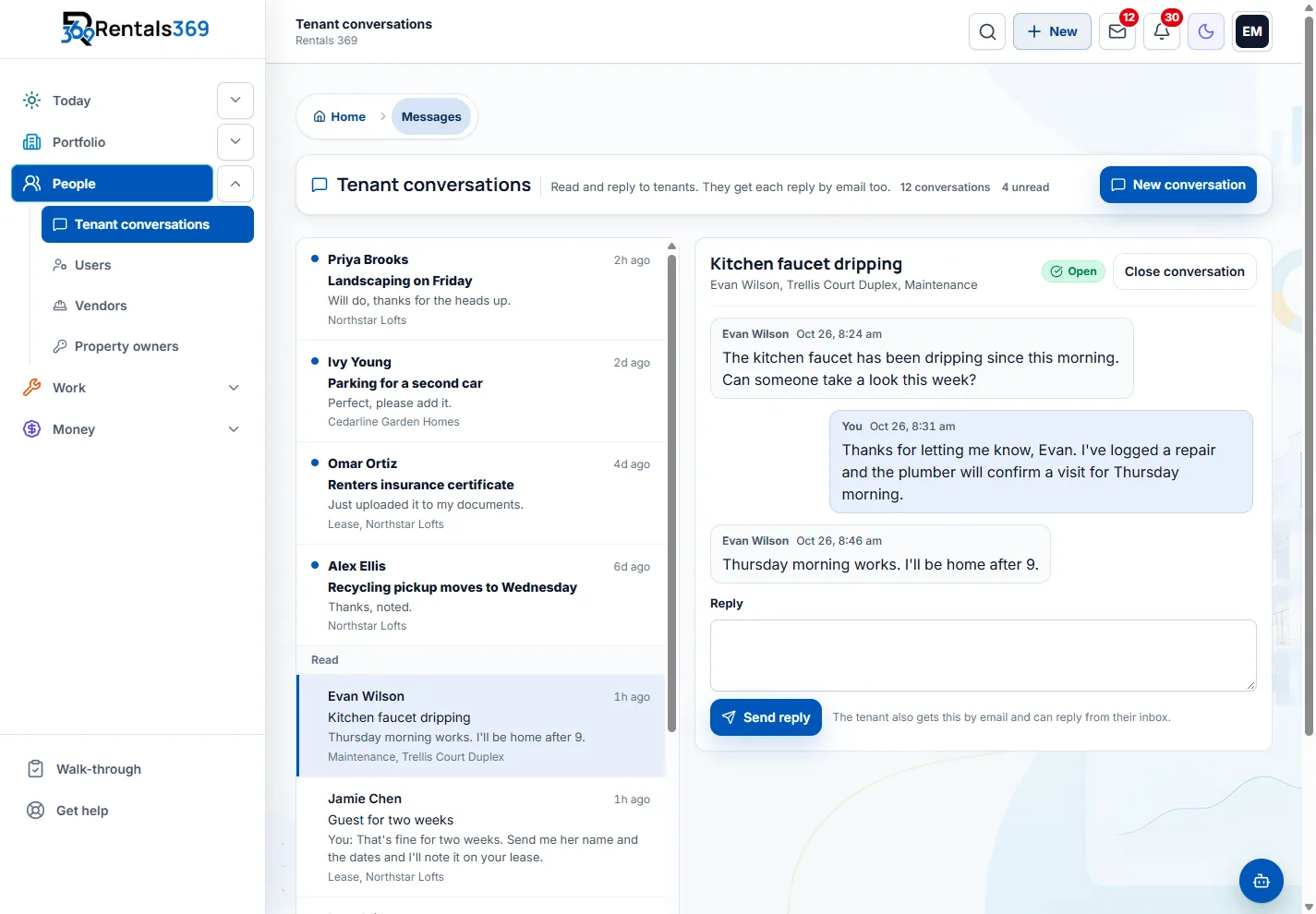
How to communicate with tenants
To communicate with tenants well, use one channel you check every day, put anything you agree in writing, reply within a time you can keep, give emergencies their own route, send formal notices the way your lease and local law require, and log every conversation. Below are each of those rules, how to text tenants professionally, and a tenant communication log you can copy or download.
Choose one channel for everyday messages
Landlord-tenant communication goes wrong when it is spread across texts, calls, and two email accounts. Pick one way for tenants to reach you about everyday things, such as a tenant portal, an email address, or a number for texts, and say so in the lease and again at move-in. Then there is one place to check and one record to keep.
When a tenant calls or texts somewhere else, answer them, then copy the message and your reply into the main record. If you can, keep the rentals apart from your personal accounts. A rental-only email address or a second phone number lets you mute rental messages after hours, and it keeps the whole history together if someone else ever takes over.
Put agreements in writing
Confirm anything you agree in person or by phone in writing, the same day. Two lines are enough:
Hi Jordan, thanks for the call today. To confirm: you'll pay the remaining $400 of October rent by October 15, plus the $50 late fee the lease allows. Reply if I have anything wrong.
Do this for payment plans, entry times, who pays for a repair, and permission for a pet or a longer guest stay. A change to the lease itself belongs in an addendum you both sign. A text that says "sure, get a cat" is weak proof of a lease change.
Set reply times you can keep
Tell tenants how fast you reply, then keep to it. For example, promise a reply within one business day for everyday messages and within an hour for emergencies. The reply can be short: you have the message, and here is when you'll have an answer.
When you're away, set an automatic reply that says who is covering and how to reach them in an emergency.
Handle after-hours messages and emergencies
Give tenants one emergency number that someone answers at any hour, and tell them what counts: a gas smell, flooding or an active leak, no heat in cold weather, an electrical hazard, or an outside door that won't lock. Everything else can wait for the next business day, and saying so at move-in sets that expectation before the first late-night text.
For a gas smell, tenants should leave the home and call the gas company or 911 from outside before they call you. For repairs, the guide to handling tenant maintenance requests covers priorities and how fast to respond.
Send notices the way your lease and the law require
Formal notices, such as notice to enter, a rent increase, a lease ending, or late rent, often have to be delivered a certain way and with a set amount of notice. Depending on your state and city, that can mean in person, by mail, or posted on the door, and a text or email may not count. Check your local law and your lease before you send one.
Keep a copy of every notice with the date, how you delivered it, and to whom. If the tenant answers by text or email, file the answer with the notice.
How to text tenants professionally
Text tenants the way you would write a short business email. These habits keep texts clear and easy to stand behind later:
- Say who you are and which rental it's about in the first message, in case the tenant hasn't saved your number.
- Send routine texts during business hours, and save evening texts for anything urgent.
- Write dates and times out in full, such as Monday, October 5, between 10 a.m. and noon.
- Keep to one topic per text, so a reply to one question can't be read as an answer to another.
- Leave out jokes, sarcasm, and all caps, which read badly out of context.
- Never discuss another tenant, and never send account numbers or passwords by text.
- Save the thread in the tenant's record whenever something is agreed, as a screenshot or an export.
A text that follows these habits looks like this:
Hi Jordan, it's Sam Rivera, your landlord at 1418 Elm Street. Delta Plumbing can fix the kitchen sink on Monday, October 5, between 10 a.m. and noon. Does that time work? If no one will be home, may they use the lockbox key?
Keep the tone calm and specific
When a tenant is upset, reply with what you're doing about the problem and by when, and leave blame out of it. If a message makes you angry, wait an hour before you answer.
Treat every tenant the same way, in what you say and in how fast you say it. Fair housing law applies to messages as well, so keep your questions to the rental and leave out anything about a tenant's family, religion, disability, or national origin.
Keep a tenant communication log
A tenant communication log is a dated list of every conversation with a tenant: when it happened, how, what it was about, what you agreed, and what happens next. Calls and visits leave no record of their own, so the log is often the only written trace of them, and it shows at a glance whether a promise was kept.
| Date | Tenant | Channel | Topic | What was agreed | Follow-up |
|---|---|---|---|---|---|
| 2026-10-02 | Jordan Lee, 1A | Text | Kitchen sink leaking under the cabinet | Delta Plumbing booked for Monday, October 5, 10 a.m. to noon. Tenant OK with entry by lockbox key. | Check with the tenant that the leak is fixed |
| 2026-10-05 | Jordan Lee, 1A | Phone call | Sink repair | Tenant confirmed the leak has stopped. | File the plumber's invoice with the repair |
| 2026-10-06 | Jordan Lee, 1A | Phone call | October rent $400 short | Remaining $400 by October 15, plus the $50 late fee the lease allows. | Email a summary today, check for payment on October 15 |
| 2026-10-15 | Jordan Lee, 1A | Rest of October rent | $450 received by bank transfer. Receipt 2026-032 sent. | None | |
| 2026-10-20 | Maria Gomez, 1B | Portal message | Asked to keep a cat | Yes, once a pet addendum is signed. | Send the addendum by October 22 |
Add a row the same day, while you remember the details. For calls and visits, write what was said in plain words, because the row is the whole record. For texts and emails, a short row is enough if you file the message itself with the tenant's records.
Download the tenant communication log template (CSV). It has the six columns above and these example rows, which you delete before you start. It opens in Excel, Google Sheets, and Numbers. The guide to what records a landlord should keep covers where the log fits with the rest of a tenant's file.